
What Are Peptides? A Simple Guide for Dummies
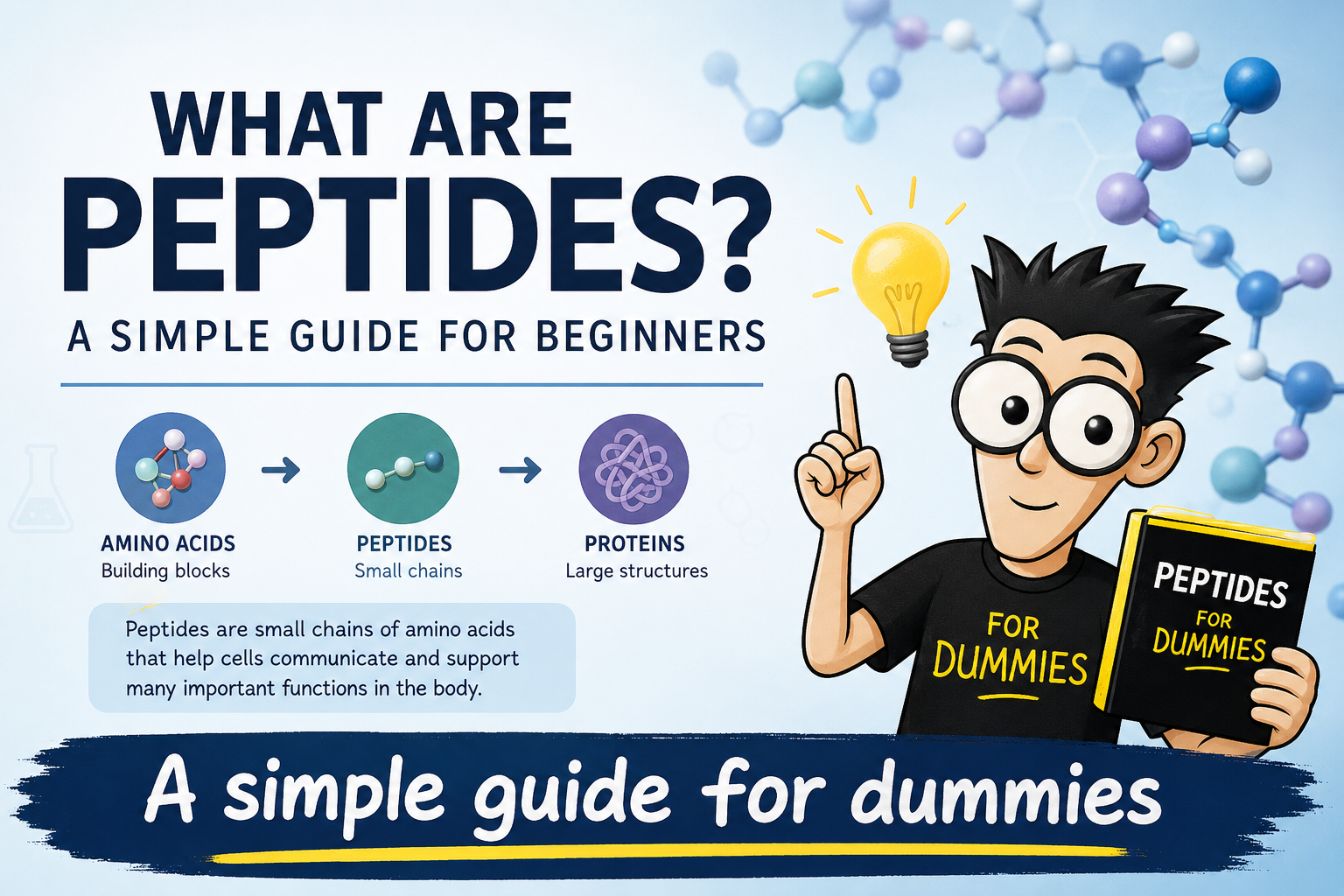
A peptide is a small chain made from amino acids.
Peptides sound complicated, but they are actually pretty easy to understand.
Amino acids are the tiny building blocks your body uses to make proteins. When a few amino acids join together, they make a peptide. When lots of amino acids join together, they make a protein.
So basically:
Amino acids = building blocks
Peptides = small chains of building blocks
Proteins = bigger, more complex chains
Think of amino acids like individual Lego pieces.
A peptide is a small Lego build.
A protein is a big Lego structure.
What Do Peptides Do?
Peptides help cells in the body communicate.
They act like little messengers. They carry instructions from one part of the body to another.
These instructions can tell the body to do things like:
Repair tissue
Support skin structure
Signal hormones
Help with immune responses
Control appetite signals
Support normal growth and development
Assist with cell communication
The body already makes many peptides naturally.
Why Are Peptides Important?
Peptides are important because they help the body know what to do.
Without messengers, cells would not communicate properly.
A simple way to think about it is this:
Your body is like a business.
The cells are the workers.
Peptides are the messages being sent between workers telling them what job needs to be done.
Are Peptides Natural?
Yes.
Your body naturally produces peptides every day.
Some peptides are involved in sleep. Some are involved in hunger. Some are involved in skin, repair, hormones, inflammation and many other normal body functions.
Scientists study peptides because they help explain how the body works.
What Are Research Peptides?
Research peptides are peptides made in a laboratory for scientific study.
They are used by researchers to study biological processes in controlled environments.
Research peptides are not sold as medicines, supplements or treatments.
They are for laboratory research purposes only.
Why Do Researchers Study Peptides?
Researchers study peptides because they can help them understand:
How cells communicate
How repair processes work
How hormones send signals
How metabolism works
How skin cells behave
How inflammation works
How different biological pathways respond
Peptides are useful in research because they can be very specific. That means one peptide may interact with one particular pathway or receptor.
What Is Peptide Purity?
Purity means how clean and accurate the peptide sample is.
For example, if a peptide is listed as 99% pure, that means the sample is mostly the intended peptide with very little unwanted material.
Purity matters because researchers need accurate results.
If a peptide sample is poor quality, it can affect research outcomes.
That is why quality suppliers provide batch testing and Certificates of Analysis.
What Is a Certificate of Analysis?
A Certificate of Analysis, often called a COA, is a document that shows testing information for a product batch.
It may include details such as:
Purity percentage
Molecular weight
Batch number
Testing method
Date of analysis
Product identity
A COA helps confirm what the product is and whether it meets expected quality standards.
How Are Peptides Stored?
Most research peptides need to be stored carefully.
Heat, light and moisture can affect peptide stability.
In general, peptides should be kept cool, dry and away from direct sunlight.
Some peptides are supplied as a dry powder. This is called lyophilised form.
Once a peptide has been mixed with a liquid, it may become less stable and usually needs more careful handling.
Always follow the storage instructions for the specific peptide.
Simple Example
Imagine your body needs to send a message.
Instead of writing an email or making a phone call, the body sends a peptide.
That peptide travels to a cell and connects to a receptor.
The receptor then tells the cell what to do.
That is the basic idea.
Peptides are biological messengers.
Are Peptides the Same as Steroids?
No.
Peptides and steroids are different.
Peptides are made from amino acids.
Steroids are made from lipids and have a completely different chemical structure.
They work differently in the body and are studied for different reasons.
Are Peptides the Same as Proteins?
No.
They are related, but they are not the same.
Peptides are smaller.
Proteins are larger and more complex.
Both are made from amino acids, but proteins usually have longer chains and more complicated structures.
Why Are Peptides Popular in Research?
Peptides have become popular because they are involved in so many important biological systems.
They are studied in areas such as:
Skin research
Metabolism research
Cell repair research
Hormone research
Immune system research
Ageing research
Exercise science research
Regenerative science
The more researchers learn about peptides, the more they understand how the body communicates at a cellular level.
Final Thoughts
Peptides are small chains of amino acids that act like messengers in the body.
They help cells communicate and play a role in many normal biological processes.
Scientists study peptides because they can help explain how the body works, how cells send signals and how different biological pathways respond.
In simple terms:
Peptides are not magic.
They are not mystery chemicals.
They are tiny biological messengers made from amino acids.
Understanding peptides starts with understanding that simple idea.
Disclaimer
Products supplied by Meditech Plus Australia are intended for laboratory research purposes only. They are not therapeutic goods, are not intended for human consumption, and are not intended to diagnose, treat, cure or prevent any disease. Researchers are responsible for ensuring all work complies with applicable laws, regulations and institutional guidelines.